Community organizing with Lucia Henry

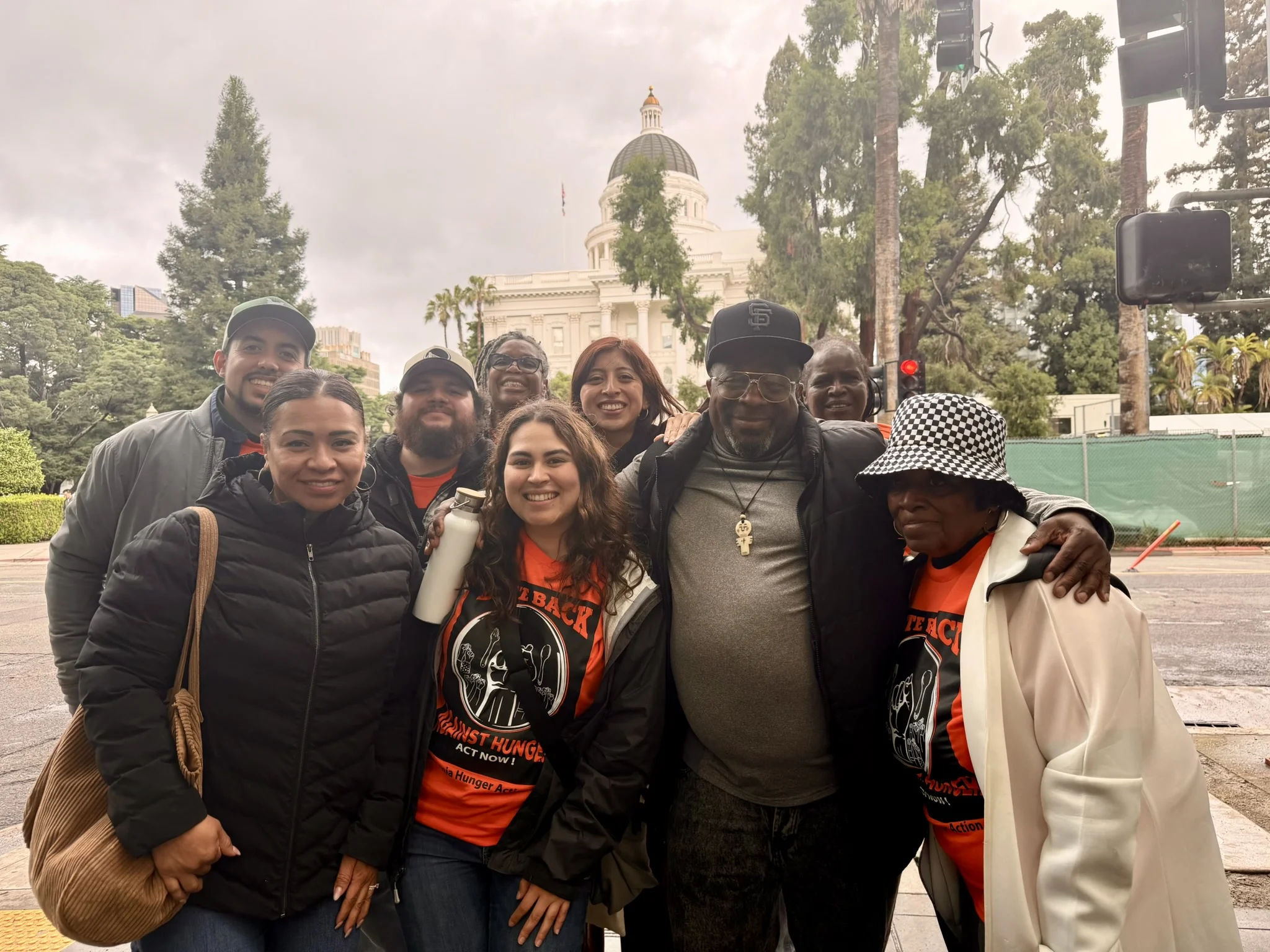
Lucia Henry (second from right) with ACCFB Food Justice Organizing Task Force members and Staff at an Alameda County Board of Supervisors Meeting
"I feel like I have a purpose. I feel like I have a very clear objective of what I'm working towards and a part of: addressing food insecurity in our county." – Lucia Henry
Meet Lucia Henry, a community organizer and member of the Food Justice Organizing Task Force. Lucia started at ACCFB as a volunteer before joining the Task Force and most recently joining ACCFB staff as a Temporary Program Liaison. We sat down with Lucia to learn about what community organizing means to her. Her reflections brought more questions than answers, as community organizing centers intentionality, curiosity, and evolving understandings of how we can work together towards food justice.
As a volunteer, Lucia packed food in the Community Engagement Center, finding a sense of sanctuary there. Lucia knew she was passionate about the intersections of homelessness, poverty, and food insecurity.
In addition to connecting with staff and volunteers at ACCFB, by volunteering with East Oakland Collective, an ACCFB partner, Lucia met people who have been working directly with hunger relief and food justice for decades.
"The direct service is very important," she says. "But at the end of the day, we're trying to address the root causes, and it's being able to empower a community to articulate what the problem is and to come together to make that change. That's why I joined the community organizing task force."
At ACCFB, Community Organizing is all about building relationships with community advocates to push for policy to end hunger and its root causes. The Food Justice Organizing Task Force is a group of community members who collaborate to build local power, challenge inequalities, and advocate for sustainable policies. This is a key part of ACCFB's movement to ensure that everyone has access to nourishing food and the power to influence the systems that affect their lives.
Since joining ACCFB's Food Justice Organizing Task Force, Lucia has been carefully figuring out what her role is and what it means to do "good work."
One role that Lucia plays is at local government meetings. There, she sees herself as "the person who can sit in the Board of Supervisors meeting, giving some visibility to the issue, because the people who are most affected, who are actually doing a lot of very, very important vital work, can't be there—because they actually do the work."
ACCFB has recently embarked on a new strategic plan and journey towards food justice and Lucia's work is one great example of how we are evolving. She explains, "I appreciate that there's so much to community organizing. It's actually about strategy and relationships. I learned the most by doing the legwork: showing up to four long Board of Supervisors meetings, having one-on-one conversations, and tracking who kept coming back to take on leadership. It's how you build real power and move a Food Bank from a charity mindset toward actual food justice."
Thanks to a collective advocacy effort, including dedication from community organizers like Lucia, who attended and spoke at many County Board of Supervisors meetings, including ones that lasted late into the night, the Board of Supervisors invested $10 million in food security from the Measure W Essential Services Fund. This historic investment will help ensure that all Alameda County residents including families, children, seniors, unhoused folks, and members of the immigrant community will have the food we all need to thrive. As federal funding cuts further threaten food security in the county, this is an essential bolster to community health.
Jocelyn Vera, a Community Organizer at ACCFB reflected on Lucia's role as a Task Force member, saying "seeing Lucia's curiosity and commitment to learning what it takes to drive change was gratifying for ACCFB organizers." She adds, "Having Lucia's curiosity, passion, commitment, and enthusiasm was a milestone in accomplishing our bigger goals of developing more community members and seeing them grow."
People are the beating heart of community organizing. Lucia explains that "with community organizing, there is an aspect of discomfort of putting yourself out there. But it's also potentially very gratifying because you're working alongside people, you're making friendships, you're making new connections with people you may not have. You're understanding the issue in a way you may not have."
When people come together, that's where the power is. "No big change has been made without people coming together…Even when it seems insurmountable, that change is still being made," Lucia says.
For Lucia, "to be working alongside people coming from all walks of life, that's the community that you have when you work for the task force…I love it." She adds, "You will find a community here. Everybody has a role to play. There's a job for you here." There's a reason it's called community organizing.
Are you ready to find your role? Read more about ACCFB's community organizing work and join the Food Justice Organizing Task Force.