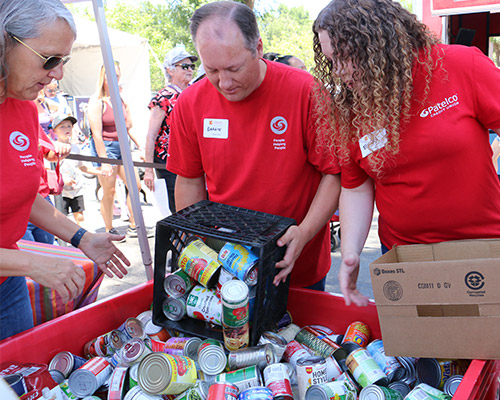
Volunteer Toxie Campbell sorts produce at an East Oakland Collective Distribution.
Since 2012, Alameda County Community Food Bank’s Food Recovery Program has served the dual purpose of reducing food waste and food insecurity, by connecting community partners with local grocery stores to source additional food for their communities. Volunteers and staff from 77 of ACCFB’s network of community partner agencies visit over 160 grocery stores where they pick up surplus food from stores, which supplements what they receive from the Food Bank.
ACCFB facilitated the recovery of 12 million pounds of groceries from local stores in 2024. This food provides agency partners and their communities with additional variety and volume of food. An estimated 30-40% of food goes to waste in the United States, which, when it ends up in landfills, produces methane, a greenhouse gas that contributes to climate change. Whenever food waste can be prevented, it reduces the environmental impact and uses fewer resources, freeing up more opportunities for agencies to provide other important services.
For ACCFB’s community partner agencies the Food Recovery Program is an essential resource that allows agencies to distribute more food with more varied options for the people who receive it. Recovered food allows agencies to save money and invest elsewhere, all while reducing waste.
“The impact of the Food Recovery Program is the grocery bags are now fuller. We went from a 30-pound bag, to maybe like 40 pounds. We’ve heard a lot of great feedback from the clients we serve, about the quality of the food. We probably have gained more clients too,” says Candice Elder, Founder and Executive Director of East Oakland Collective.
In addition to the increased variety of food produce, milk, dairy, meat, and shelf-stable foods, the Food Recovery Program allows East Oakland Collective to distribute fresh flowers to their clients. Elder notes “a special touch which I always talk about is the flowers and the plants that come from Trader Joe’s. Our clients don’t expect a dozen roses from a food pantry. People get to pick which one they want — it’s definitely a nice touch.”
With the high cost of living including high grocery prices, food sourced from the Food Recovery Program provides a valuable supplement to ensure that community members can put food on the table while still being able to afford rent and other basic necessities. “Being able to have additional stuff makes people really happy and I think that’s why a lot of them are drawn to us. Because they really appreciate the meats and fresh produce that comes in,” explains Candi Thornton, Director for Arsola’s House Distribution Center and Community Services.
When agencies, grocery stores, and the Food Bank work together, we reduce waste and distribute more food to people experiencing food insecurity in Alameda County. This is a win for the community and a win for the environment!